A colony of crested auklets. Photo credit: Alexis Will
Signals from seabird colonies
Arctic insights from Alaska’s auklets and murres


The continental shelves of Alaska’s Bering and Chukchi seas are connected by currents, sea ice and migration routes. Each sea supports distinct, ecologically important habitats, some with high economic value. Both are central to coastal communities and critical to the animals that depend on their waters. And as ALEXIS WILL writes, the area’s seabirds are one of the clearest indicators of how these connected seas are changing.
They’re back!” I whisper with excitement as I bend to examine what looks like a congealed glob of miniature, sunset-orange jellybeans splayed on the side of a lichen-covered rock. To my right, deep hooting and barking noises erupt from the rocks, while overhead there is a burst of vigorous flapping as auklets wheel by.
It’s a good day in this auklet colony in the northern Bering Sea: the sun is shining, and the ocean is—at least according to this little mound of regurgitated auklet food—full of copepods.
(Auklets feed on Neocalanus copepods, which have carotenoid pigments—so partially digested regurgitations look like the orange blobs that I saw. Their appearance means these seabirds are feasting.)
When I look at a map of Alaska’s Bering and Chukchi seas, I see a network of seabird colonies.
—Alexis Will, marine biologist with the WWF Oceans Team
Seabirds as a barometer of ecosystem health
When I look at a map of Alaska’s Bering and Chukchi seas, I see a network of seabird colonies. One string of them flows out along the Aleutian chain, while another dots the mainland coast and a third snakes its way up through the middle of the Bering Sea. In the summer, seabirds return to these breeding colonies, finding safety in numbers and capitalizing on the food boom. Seabirds are indicators of a marine ecosystem’s health. They are relatively easy to study, and they rely on the building blocks of the marine food web—zooplankton and small forage fish—to feed themselves and their chicks.
Like other Arctic seas, the Bering and Chukchi seas’ ecology starts with ice. How much sea ice forms in the fall and how long it remains determine the ocean temperatures, the availability of cold water at the bottom of the water column, and the type, amount and distribution of zooplankton and forage fish. The huge colonies of auklets in the northern Bering Sea rely on icy conditions and northward-flowing currents to deliver the Neocalanus copepods that make up their diets.
In 2018—a year characterized by historically low winter sea ice—something changed. Perhaps the copepods never arrived, or their timing shifted, or the currents changed, keeping them further offshore, where the auklets could not reach them. In any event, the colonies went silent. For three years.
Parents abandoned their chicks early. Some chicks never hatched. One year, chicks were found wandering outside their crevice nests, starving.
This challenging period was followed by a few unremarkable years. The auklets struggled less, yet the colonies didn’t fully rebound. But for the last two years, the colonies have been full again, bustling and exhibiting the health and vigour of 20 years ago—because the ice and the copepods came back. Climate change in this area seems to be manifesting as increased variability rather than continuous warming.

A murre flying over calm water. Photo credit: Serguei Drovetski
What murres can tell us
But auklets are not the only birds that have something to tell us about how an area is changing. Many Arctic species migrate within the Arctic or come and go as seasonal visitors. For example, common and thick-billed murres tend to crowd Arctic colonies in the summer, but disperse south to ice-free waters in the winter. Both birds nonetheless play significant roles in the cultures of many Arctic peoples: their dense feathers have provided coverings for parkas, and the birds are critical components of the annual harvest, especially their large, rich, blue speckled eggs.
The murres are also a reminder that important ocean areas are connected. About 10 years ago, a severe marine heatwave struck the Gulf of Alaska (not the Arctic), and it precipitated a wave of ecological disasters, hitting all levels of the food web. Among these was an unprecedented die-off of common murres. We examined wings collected from dead murres and, using machine learning and stable isotope analysis, matched these to colonies in the Bering Sea. During a recent study, our colleagues at the US Fish and Wildlife Service examined their records and found that an estimated four million common murres were “missing” from the Bering Sea population.
Collaborating to understand and confront change
In Alaska, people are finding ways to address these changes. As researchers, we work with colleagues to understand how ecosystems are changing and how species like seabirds are likely to respond. Community members are working alongside researchers, adding their insights and knowledge to help evaluate the stressors that species are experiencing. Together, we are coming up with ways to safeguard the future through tangible means.
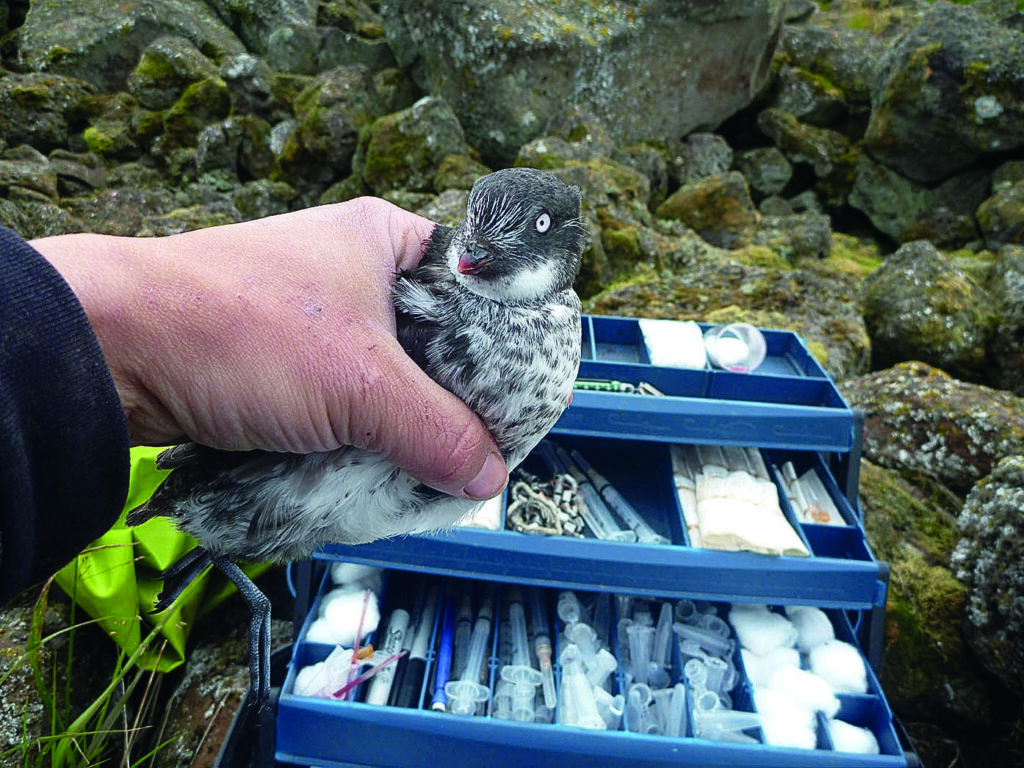
Alexis Will finishes sampling blood and feathers from a least auklet to learn more about what stressors it has been experiencing. Photo credit: Alexis Will
For me, that is by contributing to programmes like Arctic Watch, building protocols for ships to ensure safe navigation in the region, and working on durable protections for Alaska Native communities’ marine cultural heritage.
We all have a role to play in protecting the Arctic—because most of the threats to the region originate elsewhere. Protection involves making a commitment to change our everyday habits. To reduce our carbon footprint and invest in the habitats around us.
The Earth is connected. That means if we want a future where crested and least auklets continue to munch on Neocalanus copepods, murres are common again, and the Chukchi and Bering seas maintain their rich species diversity, then we all need to work towards a sustainable future.


By Alexis Will
Marine biologist, WWF
ALEXIS WILL is a marine biologist with the WWF Oceans Team. She is building a research programme for the US Arctic to support wildlife monitoring and area-based conservation work.