
A new project aims to give the gyrfalcons a little help with their nest building. Photo credit: BirdLife Sverige
News
Artificial nests help endangered gyrfalcon adapt to climate change
- Climate Change
- Sweden
New project provides the avian giant with weatherproof places to breed, sheltered from extreme precipitation and wind
Something special is happening among the mountains of Vindelfjällen in northern Sweden. The gyrfalcon – the world’s largest falcon and a top avian predator of the Arctic ecosystem – is under increasing threat from climate change.
But there is hope.
Suffering from higher chick mortality
In a collaboration between WWF, BirdLife Sverige and the Swedish University of Agricultural Sciences, a new project aims to reduce the species’ climate vulnerability by giving them a little help with their nest building.
One of the reasons for their struggles is believed to be weather related, specifically warmer, wetter winters. This can make it more difficult for the gyrfalcon to time its breeding and secure its food supply. Unlike many Arctic species, gyrfalcons do not migrate south for winter, meaning they are unable to shift their range in response to changing weather conditions.
Because they often reuse old raven nests on high cliff ledges, heavy spring rainfall and strong winds are believed to destroy these exposed nests and cause high chick mortality. This instability means fewer secure ledges or intact raven nests each year, further limiting available breeding sites.

The project is currently preparing 10 to 15 artificial nests that imitate raven nests but are more durable and securely fixed. Photo credit: Navinder Singh, Swedish University of Agricultural Sciences
Imitating old raven nests
WWF and its partners will install artificial, climate-resilient nest platforms on cliffs, giving gyrfalcons safe places to breed that are sheltered from extreme precipitation and wind.
“By securing more stable nest sites, we hope to buffer the falcons against adverse spring weather and boost chick survival,” says Therese Wåtz, WWF Sweden’s programme manager for species and project lead in Vindelfjällen.
Wåtz and her colleagues are currently working on installing 10 to 15 artificial nests that imitate raven nests but are more durable and securely fixed. Installation takes place outside of the breeding season, between late summer and December. The artificial nests are relatively low-cost and designed to benefit gyrfalcons for many years.
Essentially, we are offering an innovative solution to help an endangered species persist in a warming Arctic.
Therese Wåtz, WWF Sweden’s programme manager for species and project lead.
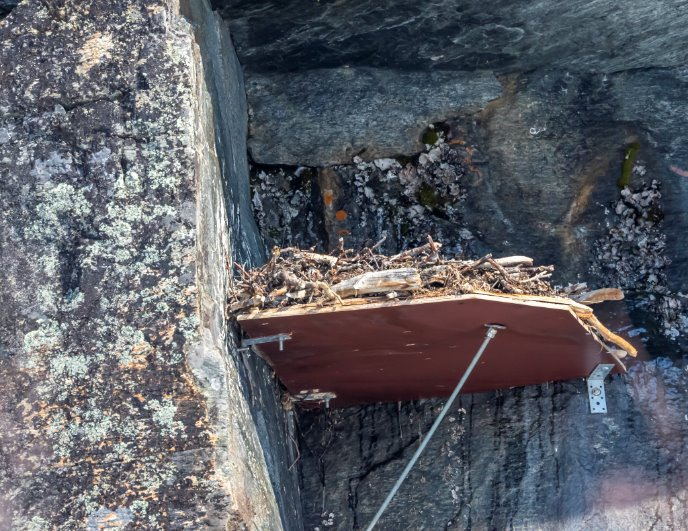
Each platform is equipped with a stabilised surface, drainage and a secure edge. Photo credit: BirdLife Sverige
Project can be scaled up
Although the project is still in its early stages, there are indications that it can be scaled up far beyond the 565,000-hectare Vindelfjällen Nature Reserve.
“If the gyrfalcons use them and experience improved breeding success, the approach can be replicated in other areas of the gyrfalcon’s range that face similar climate-related challenges,” says Wåtz.
For example, additional artificial nests could be installed in other mountainous parts of northern Sweden or across the border in suitable habitats in Iceland, Norway and Finland. Pilot research from Norway has already shown that providing artificial nest sites can initiate or stabilise gyrfalcon breeding in areas where natural sites are lacking, helping to maintain viable populations.
Some of the installed nests are accompanied by cameras that monitor the falcons’ activities and progress – and already, there are encouraging stories to tell:
By WWF Global Arctic Programme


