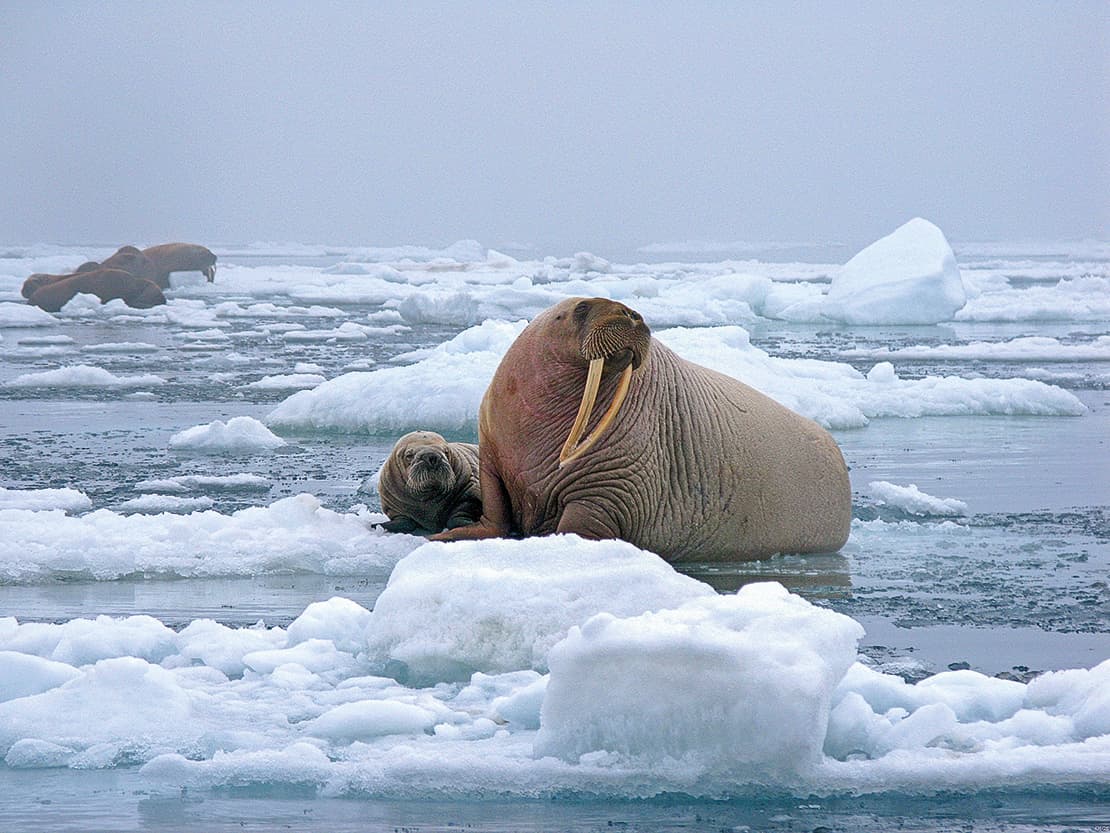
© Andrea Sparrow / Arctic Arts Project
News
Cryosphere decline is beyond safe planetary limits, putting Arctic living conditions at risk
- Climate Change
New scientific study warns that land ice, sea ice, snow cover, and permafrost declines have already crossed safe levels. Urgent international action is required.
The study, published in the journal Science, finds that human-driven climate change is degrading these landscapes beyond safe environmental limits. This threatens Earth conditions on which humanity fundamentally depends.
Likelihood of catastrophic flooding and drought
The research states that the degradation of the cryosphere, the components of Earth that are frozen, poses increasing long-term risks to the planet, its ecosystems, and human societies.
Frozen landscapes play an irreplaceable role in regulating the Earth’s energy, water, carbon, methane cycles, and carbon storage capabilities.
Accelerating global temperature, sea level rise, ecosystem degradation, and the likelihood of catastrophic flooding and drought events – pose a threat to communities especially in polar, high-mountain, coastal, and low-lying regions.
The state of degradation of frozen Arctic landscapes and seascapes is not only terrible news for Arctic biodiversity and people calling the Arctic home, it has reached a level where it threatens the Earth system conditions on which ecosystems and people all around the world depend.
Martin Sommerkorn, Head of Conservation at WWF’s Global Arctic Programme, and co-author of the study.
Beyond safe operating space
The study, published as part of the UN Decade of Action for Cryospheric Sciences, warns that a return to desirable conditions is becoming increasingly difficult.
“The cryosphere has already exceeded its planetary safe operating space, threatening the frozen foundations of our planet that have supported human civilisations for millennia,” said Dr. Bo Su, lead author of the paper and researcher at Stockholm Resilience Centre and Beijing Normal University.
The degradation of frozen landscapes is driven predominantly by human-induced climate change. Added to this are black carbon emissions and industrial and infrastructure expansion.
Springboard for change
The study, which coincides with COP31 in Antalya, Türkiye (November 9-20), offers a comprehensive, scientific springboard for coordinated, international action.
The authors urge policymakers to develop precautionary targets and strategies to limit emissions of greenhouse gases and black carbon and reduce local human disturbances – all key causes of cryosphere decline.
“This paper asserts how critical the cryosphere is in determining a safe operating space for humanity. Policymakers must increase their speed and ambition to return global temperatures to safe levels as soon as possible,” Sommerkorn concludes.
Citation: Bo Su et al. ,The cryosphere beyond a planetary safe operating space.Science0,eaef5636 DOI:10.1126/science.aef5636
Further reading
In November 2026, the UN published its Overshoot and the Cryosphere report. It states that permanently exceeding the 1.5°C limit will bring global and often irreversible damages to the cryosphere and polar oceans. We present six ways a temperature overshoot will affect the Arctic.
By WWF Global Arctic Programme