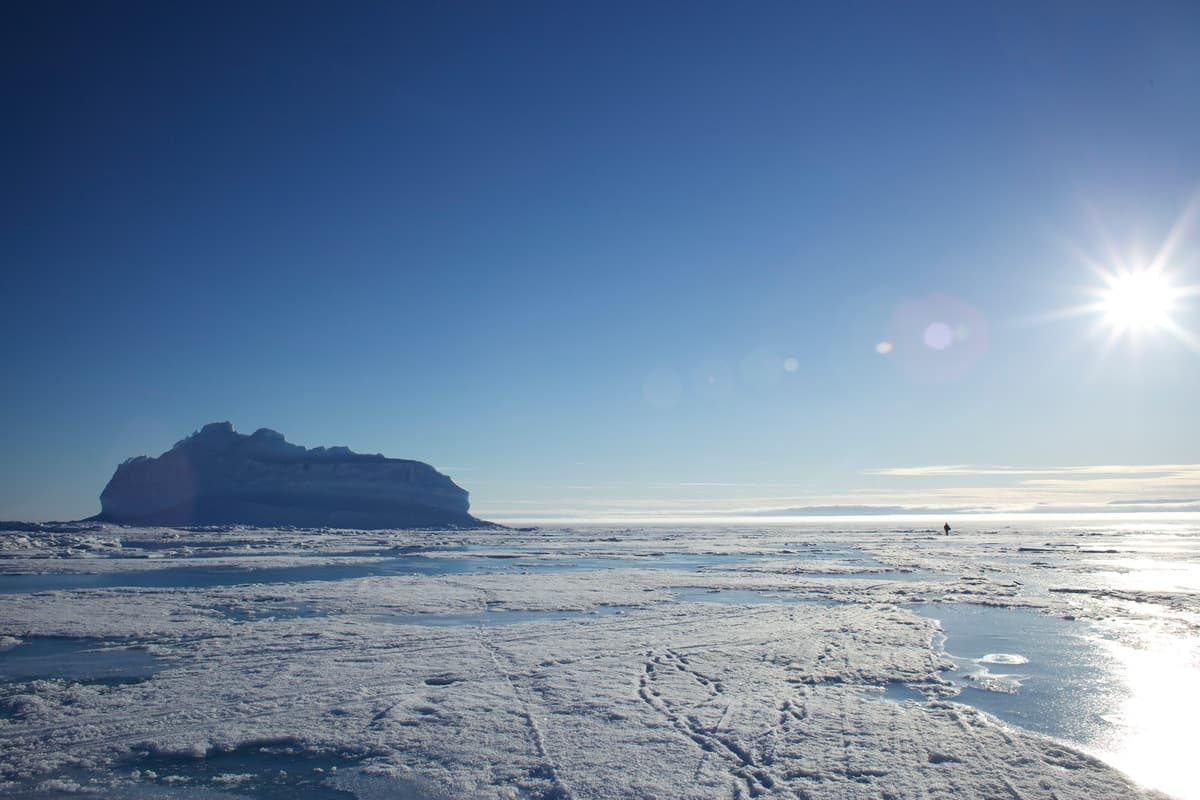
The bed of a stream draining the east side of Twin Glacier,
at the head of a valley south of Alexandra Fjord on
Ellesmere Island, Nunavut, Canada. Photo credit: Martin Brummell (distributed via imaggeo.egu.eu) CC BY 3.0
More than ice
A living continuum
The Last Ice Area is expected to be the Arctic’s final refuge for multi-year sea ice. But the region is so much more than ice. As MATHIEU ARDYNA writes, it is an ecological network that includes land, glaciers, sea ice, ocean and seafloor. Understanding how these are all connected is becoming urgent as this remarkable system transforms.
At the northern edge of Canada and Greenland lies one of the most extraordinary landscapes on Earth. Mountains and glaciers meet narrow fjords, sea ice stretches towards the horizon, and the ocean remains largely unexplored.
Known as the Last Ice Area, this region is expected to retain Arctic sea ice longer than anywhere else in the world.
But even there, change is already underway.

The glacier-ocean continuum in the Last Ice Area. These images illustrate the diversity of glacier
types and their influence on coastal waters: Petermann Glacier, northwest Greenland (A);
Prince of Wales Icefield, Ellesmere Island (B); Manson Icefield, Ellesmere Island (C); and Devon
Ice Cap, Devon Island (D). The variations in ocean colour reveal contrasting inputs of glacial
sediments and meltwater, highlighting the strong connections between glaciers and adjacent
marine ecosystems.
Look beyond the sea ice
Thinking of the area as simply a frozen refuge misses much of what makes it exceptional. Freshwater and particles flow from land and melting glaciers into coastal waters (see photos).
Sea ice controls how much light reaches the ocean. Ocean currents redistribute heat and nutrients. All these processes influence where and when life can flourish.
But the linked landscapes of the Last Ice Area are transforming because the climate is warming. As multi-year ice declines, glaciers melt and ocean circulation changes, altering the movement of freshwater, nutrients and energy through the ecosystem. These changes do not stop at the edge of the ice or at the coastline—they spread through the entire ecosystem.
The Last Ice Area is far more than just a frozen ocean—it is an integrated system where coastal habitats, the water column and the deep seafloor exchange energy and organic matter.
That is why understanding and protecting the future of the Last Ice Area requires us to look beyond the sea ice itself.
A hidden world
Some of the most important parts of this ecosystem are the hardest to see. Microscopic algae grow within and beneath the sea ice.
Phytoplankton can form blooms in the water column, sometimes unseen by satellites looking down from space. And because much of the Last Ice Area is relatively shallow, sunlight can reach the seafloor, where macroalgae and microscopic benthic algae may represent another important source of primary production.
Yet we still know remarkably little about how these different components interact or how much each contributes to the ecosystem.
Seafloor surprises
During the 2024 REFUGE-ARCTIC expedition aboard the Canadian research icebreaker CCGS Amundsen, an unexpected observation brought these elusive relationships into sharper focus.
At the entrance to Archer Fjord, our remotely operated vehicle discovered large accumulations of detached kelp on the seafloor, hundreds of metres below the surface:

Detached kelp deposits rest on the seafloor at the entrance of Archer Fjord in the Last Ice Area. These illustrate an unexpected connection between productive coastal habitats and deep benthic ecosystems.

Detached kelp deposits rest on the seafloor at the entrance of Archer Fjord in the Last Ice Area. These illustrate an unexpected connection between productive coastal habitats and deep benthic ecosystems.
More than just a frozen ocean
Finding marine macroalgae in one of the Arctic’s iciest regions drives home the point that the Last Ice Area is far more than just a frozen ocean—it is an integrated system where coastal habitats, the water column and the deep seafloor exchange energy and organic matter.
Understanding these links is one of the main goals of REFUGE-ARCTIC, an international research programme that is investigating the Last Ice Area as a single interconnected ecosystem.
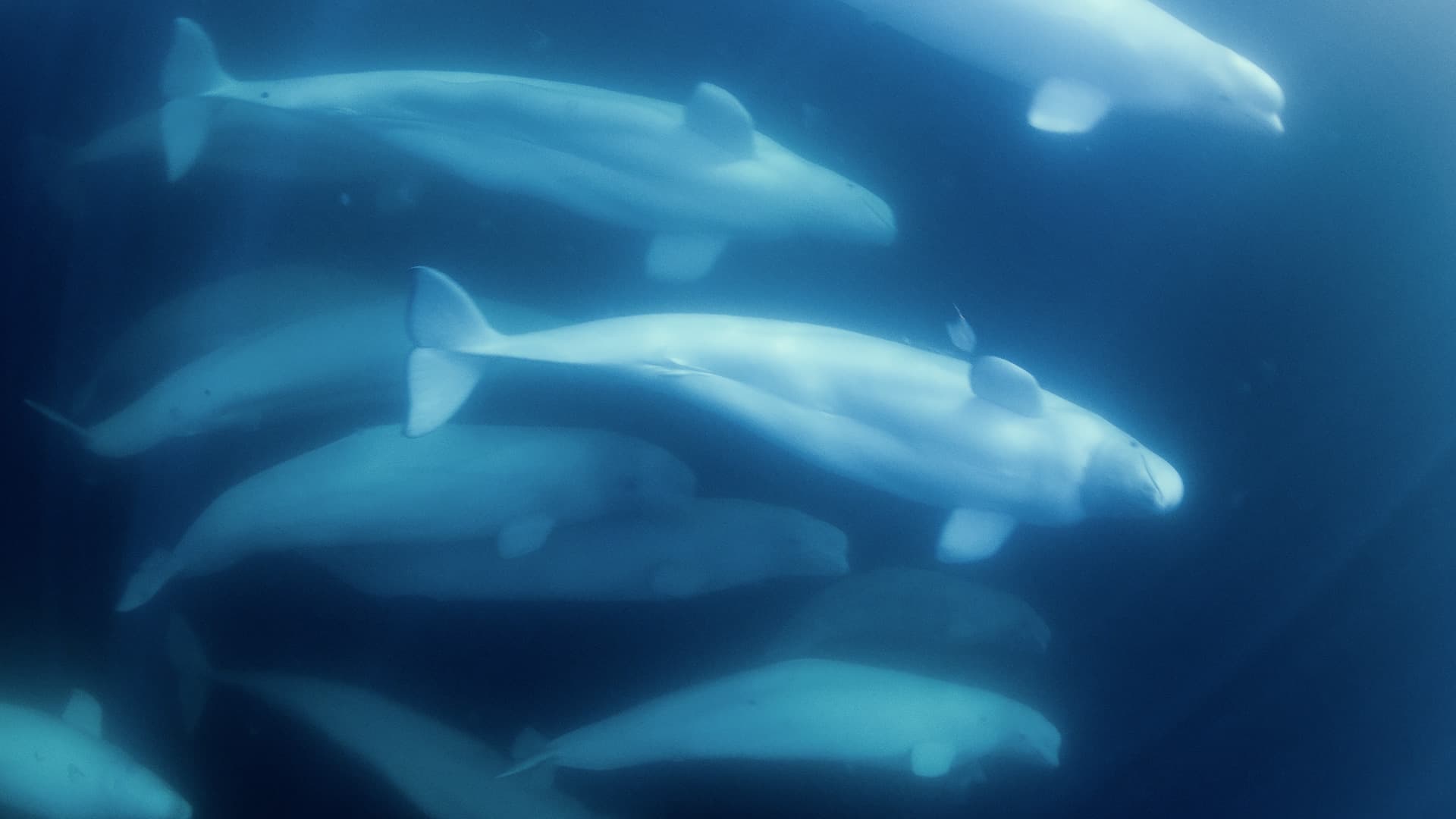
Those connections matter because primary production is only the beginning of the story. The carbon captured by algae can follow different pathways. Some enters the food web, supporting zooplankton, fish and ultimately large Arctic mammals, such as seals, walruses and narwhals. Some sinks through the water column and reaches the organisms that live on or within sediment on the seafloor.
Rich benthic life
In Archer Fjord, our observations also revealed an intriguing paradox: the water column had relatively low biological productivity (production of new organic matter), yet the ecosystem was capable of supporting rich benthic life (organisms living on, in or near the bottom of the ocean) and marine mammals.
But where does the energy that sustains this ecosystem come from? Following carbon from sea ice, phytoplankton and benthic producers through the ecosystem may help answer that question.
Preparing for a changing ecosystem
This is also why establishing a baseline now is so important. The Last Ice Area of the future will not simply contain less ice. The relationships linking glaciers, sea ice, ocean productivity, the seafloor and animals may also be reorganized.
Some productive habitats could expand as more light becomes available, while others that depend on persistent sea ice could shrink. Changes in the timing or location of primary production could alter when and where food is available to the rest of the ecosystem.
For conservation, understanding these processes is crucial. Protecting the Last Ice Area does not mean protecting sea ice alone. We need to understand how the entire ecosystem functions, including the parts that remain largely invisible.
Scientific observations can help identify which habitats are particularly productive, how they work together, and which may be most vulnerable as environmental conditions change.
Note: Information, findings, and viewpoints presented in articles authored by external contributors are their own and do not necessarily represent WWF positions, policies, or interpretations. For general inquiries, please email info@arcticwwf.org.


By Mathieu Ardyna
Oceanographer and Assistant professor
MATHIEU ARDYNA is a biological oceanographer with IRL Takuvik, an international research project jointly run by Laval University in Canada, Sorbonne University in France, and France’s Centre national de la recherche scientifique (CNRS) that is studying how climate change is transforming marine ecosystems across the Arctic Ocean.