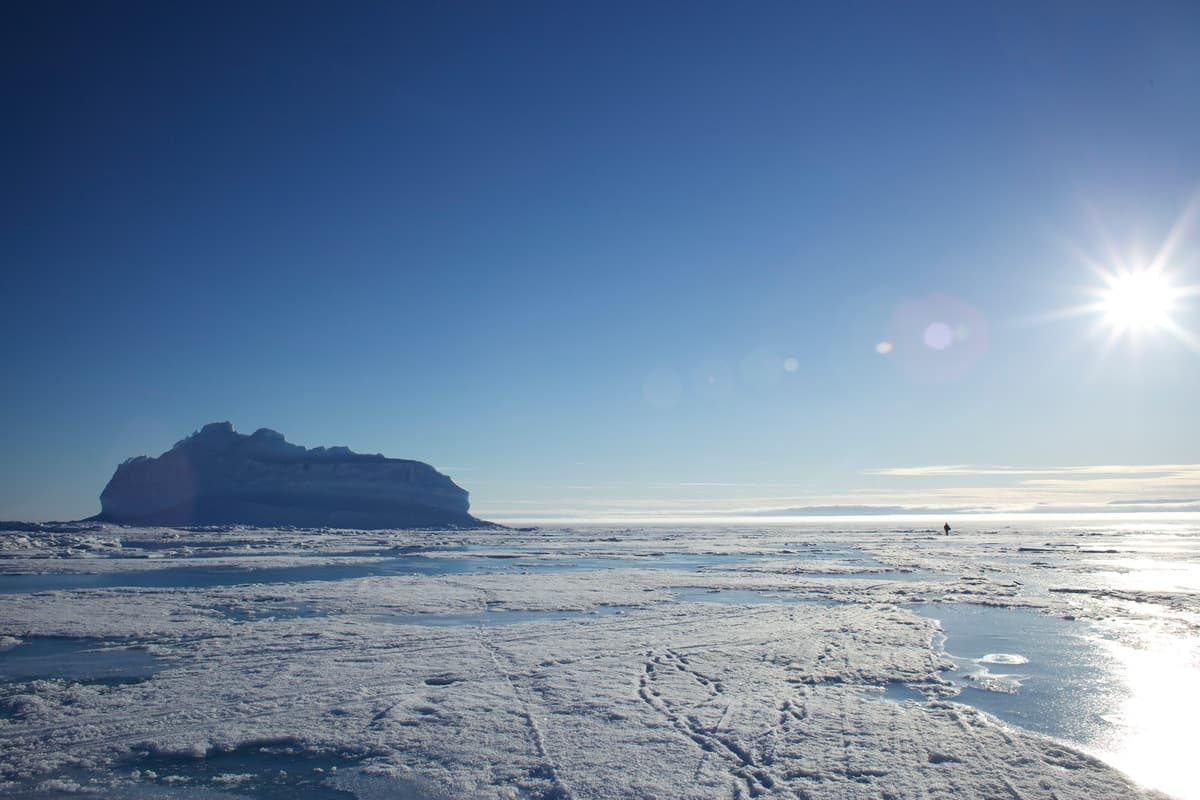
A pressure ridge in the late afternoon light, photographed from the icebreaker Oden during the Arctic Ocean 2016 expedition. The ridge measured about five metres across and two metres high. Credit: Grace Shephard (distributed via imaggeo.egu.eu) CC BY-NC 3.0
Sea ice dynamics
The Last Ice Area doesn’t stand alone
The Last Ice Area is widely considered the Arctic’s final refuge for ice-dependent species. But as BRUNO TREMBLAY and ELOÏSE JOUBERT write, its existence depends on sea ice formed thousands of kilometres away. What happens elsewhere in the Arctic will determine whether the area can continue to provide sanctuary for the species that depend on it.
Many people picture Arctic sea ice as a vast, frozen landscape, fixed in time and place. But in reality, it is constantly on the move, forming along Arctic coasts, drifting across the ocean for years or even decades, and eventually melting.
The duration of this journey depends not only on winds and ocean currents, but on one key property: thickness. Thinner ice has a shorter lifespan in the Arctic, while the “quality” of the ice that reaches the Last Ice Area depends greatly on its birthplace.
The Last Ice Area is not an isolated sanctuary. It is the downstream end of a dynamic Arctic-wide system.

Arctic sea ice is constantly on the move. This map shows the two dominant circulation patterns—the Beaufort Gyre
and Transpolar Drift Stream—that transport ice across the Arctic and help supply the Last Ice Area. Map design: Ketill Berger, ketill.berger@filmform.no. © WWF Global Arctic Programme
The circulations that create the ice
Large-scale atmospheric circulation drives two dominant pathways for Arctic sea ice: the clockwise Beaufort Gyre in the western Arctic, and the Transpolar Drift Stream, which carries ice from the Eurasian coast across the pole, through Fram Strait, and out of the Arctic (see map).
Near the boundary between these systems, drifting ice converges along the Canadian coast, where it fractures and piles up into thick ridges—typically five or six metres thick, although 25 metres or more is possible in areas of intense compression.
Some of this thick ice is recirculated by the Beaufort Gyre, while some enters the Canadian Arctic Archipelago, where it effectively becomes trapped among hundreds of islands.
This combination of transport, thickening and retention explains why the archipelago and the region to its north have historically supported one of the Arctic’s largest reservoirs of perennial sea ice—the region we now call the Last Ice Area.
Changing ice supply
But as the Arctic warms, sea ice in the area is becoming thinner and more prone to breaking apart. Faced with the same winds, thinner ice moves more easily and spends less time in the Arctic Ocean, limiting its ability to thicken and allowing more ice to drift away.
Equally important is the warming of North Pacific waters that enter through the Bering Strait in spring and summer and short-circuit the recycling of thick multi-year ice in the Beaufort Gyre.
Instead, thinner first-year ice (ice that has formed during a single winter) enters these circulation patterns and is carried forward. Climate models project that the Last Ice Area will be the last remaining refuge for species that depend on sea ice.
Changing quality and quantity of ice
While the existence of the Last Ice Area depends mainly on atmospheric circulation and Arctic geography, the thickness and resilience of the ice within it depend on the ice that feeds it.
This upstream source region—the Last Ice Area’s “ice shed,” so to speak—extends from parts of the Eurasian Arctic to the Alaskan and Yukon coasts, where ice forms before entering the Beaufort Gyre and Transpolar Drift Stream.
Much like a watershed that supplies water to a lake or river system, the ice shed supplies the raw material that sustains the Last Ice Area. As a result, environmental changes and human activities in these distant regions—including shipping, tourism, mining and resource extraction—can influence the quantity and quality of the ice that eventually reaches the Last Ice Area, with consequences for the ecosystem it supports.
In short, the Last Ice Area depends on the quality of the sea ice that forms far beyond its own boundaries.
When the reservoir begins to drain
Recent high-resolution climate models simulating the movement of sea ice through the narrow channels of the Canadian Arctic Archipelago show that the thick ice north of the archipelago could be drained through these pathways in as little as 15 years.
As the Last Ice Area allows more ice to escape, it may no longer act as a reservoir that retains thick multi-year ice. Instead, this ice may increasingly drift southward into warmer waters, where it will melt.
The ecological consequences could be profound. Sea ice supports a rich web of Arctic life, from ice algae and plankton to iconic marine mammals.
As sunlight penetrates the ice in spring, the algae that grow beneath the ice provide food for zooplankton, fish and species higher in the food web.
Ringed seals, polar bears and other ice-dependent species rely on stable sea ice to rest, breed, hunt and raise their young. As sea ice declines, habitats shrink and food webs are disrupted, forcing these Arctic specialists to adapt.
International protection needed
Within Canadian waters, protected areas such as Tuvaijuittuq (an Inuktitut word meaning “the place where the ice never melts”) and Tallurutiup Imanga constitute important conservation measures.
Internationally, areas of the Central Arctic Ocean proposed for protection under the High Seas Treaty could help safeguard part of the ice shed that feeds the Last Ice Area. These actions can help preserve this unique ecosystem.
Ultimately, the future of the Last Ice Area depends on limiting global warming and maintaining the supply of thick, resilient sea ice on which the area depends.
The Last Ice Area is not an isolated sanctuary. It is the downstream end of a dynamic Arctic-wide system. Protecting it requires conserving not only the area itself, but the larger Arctic system—and climate—that creates and replenishes it.
Note: Information, findings, and viewpoints presented in articles authored by external contributors are their own and do not necessarily represent WWF positions, policies, or interpretations. For general inquiries, please email info@arcticwwf.org.


By Bruno Tremblay and Eloïse Joubert
BRUNO TREMBLAY is a professor in the Department of Atmospheric and Oceanic Sciences at McGill University in Canada. ELOÏSE JOUBERT is a master’s student in the Department of Atmospheric and Oceanic sciences at McGill University.