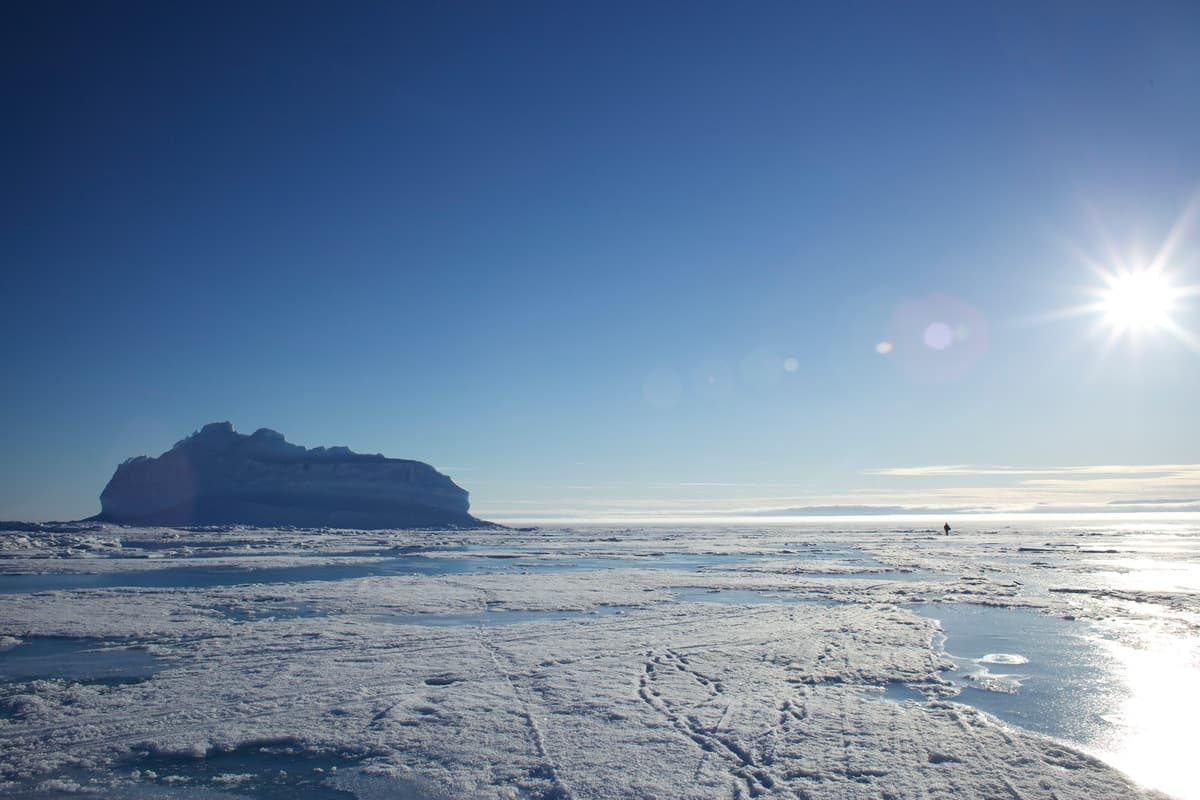
Photo credit: Andreas Preußer distributed via imaggeo.egu.eu. CC BY-ND 3.0
Northeast Greenland
New polar bear denning behaviour in the Last Ice Area
Northeast Greenland is one of Earth’s most remote, least studied regions—a landscape of multi‑year sea ice, annual fast ice and drifting annual pack ice, with hundreds of icebergs that are grounded on the seafloor or become frozen into the ice for years at a time. Its coastline forms part of the northern gateway to the Last Ice Area.
In 2019, researcher KRISTIN LAIDRE and her late colleague Ian Stirling noticed something unusual: there were polar bear maternity dens among the region’s icebergs along the northeastern and northern coasts. Laidre, a scientist with the Polar Science Center at the University of Washington, has worked in Greenland for some 25 years and studied polar bears since 2009. She spoke to The Circle about the discovery and what it reveals about how polar bears use this extreme environment.
How did you discover that polar bears were establishing dens in icebergs?
Accidentally. We had started an assessment of the East Greenland subpopulation. We had been working on that programme for eight years, and we spent one of our final years in northern and northeastern Greenland, extending into the Last Ice Area.
I was there to get a handle on the number of polar bears in the area, collect genetic samples, capture family groups, and fit adult female bears with satellite tracking collars to study their movements. We would use the information we collected to design a survey of the East Greenland polar bear subpopulation.
What did you find while preparing for the survey?
We were searching for polar bears out on the sea ice. Every observation counts, especially in an area like northern Greenland, where historically, very little scientific effort has been expended.
This area of Greenland has many icebergs on the coast that can get frozen into the multi year ice and become fixed in place for one or more years. Snow blows across the sea ice and hits these icebergs, forming drifts up against them. This creates good habitat for maternity denning.
We noticed what looked like a maternity den. You could see tracks from a family group—including really small cubs’ footprints in the snow. We landed the helicopter on the ice, investigated the footprints, and walked up to the den in the iceberg. You could see that bears had been using these iceberg structures that are fixed in the sea ice as a framework for digging their dens. We continued to find similar dens all over the area.

Kristin Laidre with two polar bear cubs during a research trip. Photo credit: Peter Hegelund
How unusual is this behaviour compared to what female polar bears usually do?
To our knowledge, it was the first time that polar bears had been recorded denning in offshore, drifted snowbanks around icebergs. Most bears move onto coastal areas where there’s a lot of geographical complexity, with hills or mountains that create similar snow drifts. Historically, bears would make dens on multi year sea ice.
But Greenland is special because there’s so much freshwater ice in the form of icebergs. The icebergs were creating the habitat.
What does this discovery tell us about the connection between polar bears and the Last Ice Area?
I think it tells us about how polar bears are using this unique area. In addition, the long term geographic predictability of maternity denning habitat is probably somewhat connected to the Greenland ice sheet and these icebergs. The Last Ice Area is arid. There’s not a lot of precipitation, so there’s not a lot of snow. You need suitable drifts for bears to be able to create maternity dens, and the icebergs sort of facilitate that.
As we transition from multi year ice to annual ice in the Last Ice Area—and as that annual ice becomes less stable—I would expect this maternity denning habitat (made up of these icebergs and the multi year ice) to decline. With warming, the icebergs will likely melt faster, the ice will break up earlier, there won’t be multi year ice to fix them in place, and they’ll probably be more mobile. Over the long term, I think that’s what might happen.
I also think this indicates that bears in the Last Ice Area are using a novel maternity denning habitat that gives them what they need to reproduce successfully. As we lose sea ice in the Last Ice Area, bears are probably going to have to transition away from iceberg denning and onto land. But will there be suitable snowdrifts on land? I don’t know. We haven’t studied that.

Circled are a polar bear in a den (left) and a seal kill on top of the iceberg (right). Photo credit: Kristin Laidre
What challenges does this kind of denning create for monitoring and conservation efforts?
It’s really hard to monitor this area. Most of the work we do on polar bears relies on helicopters or airplanes. Even just accessing the Last Ice Area and working up there is really logistically challenging. If we want to invest in understanding the Last Ice Area and have good data from the area to predict what’s going to happen in the future, we need support for research. It’s neither cheap nor easy to monitor this remote area.
But I think it gives us an indication that polar bears, depending on their habitat and what’s accessible to them, can be pretty creative. Bears in the Southeast Greenland subpopulation are using the ice sheet as supplemental summer habitat—though not directly. They use glacial mélange, a mixture of calved freshwater ice chunks and sea ice.
It also tells us there’s still a lot to learn. These are just observations from a couple of days spent flying in the areas we could access. I suspect that if we put effort into a bigger research programme, we would probably learn a lot.
What could you do with this research in the future?
I’d be very interested in getting back up there and doing more intensive sampling. With several years of repeat sampling, you’d learn a lot about how bears are using the region. You could collar some bears and look at how they are using the coastal areas of the Last Ice Area or the offshore region. You could also get a sense of whether bears use the same regions of the Last Ice Area year after year or are more transient. You would also be able to see to what extent they are using the Arctic Basin and get an idea of local abundance.
And if we were to capture bears, we would obtain a huge suite of health information. We could also look at genetics and subpopulation origin. There are definitely bears from the Kane Basin subpopulation that move into the Last Ice Area—we have tracked several that came from the western coast of Greenland. We also know the area is used by bears from the East Greenland subpopulation. But is it also used by bears from elsewhere?
There are many, many questions you could answer if it were possible to engage in a multi year research effort in the region.
READ MORE: The observations described here are published in more detail in the journal Polar Biology.
Note: Information, findings, and viewpoints presented in articles authored by external contributors are their own and do not necessarily represent WWF positions, policies, or interpretations. For general inquiries, please email info@arcticwwf.org.
By WWF Global Arctic Programme