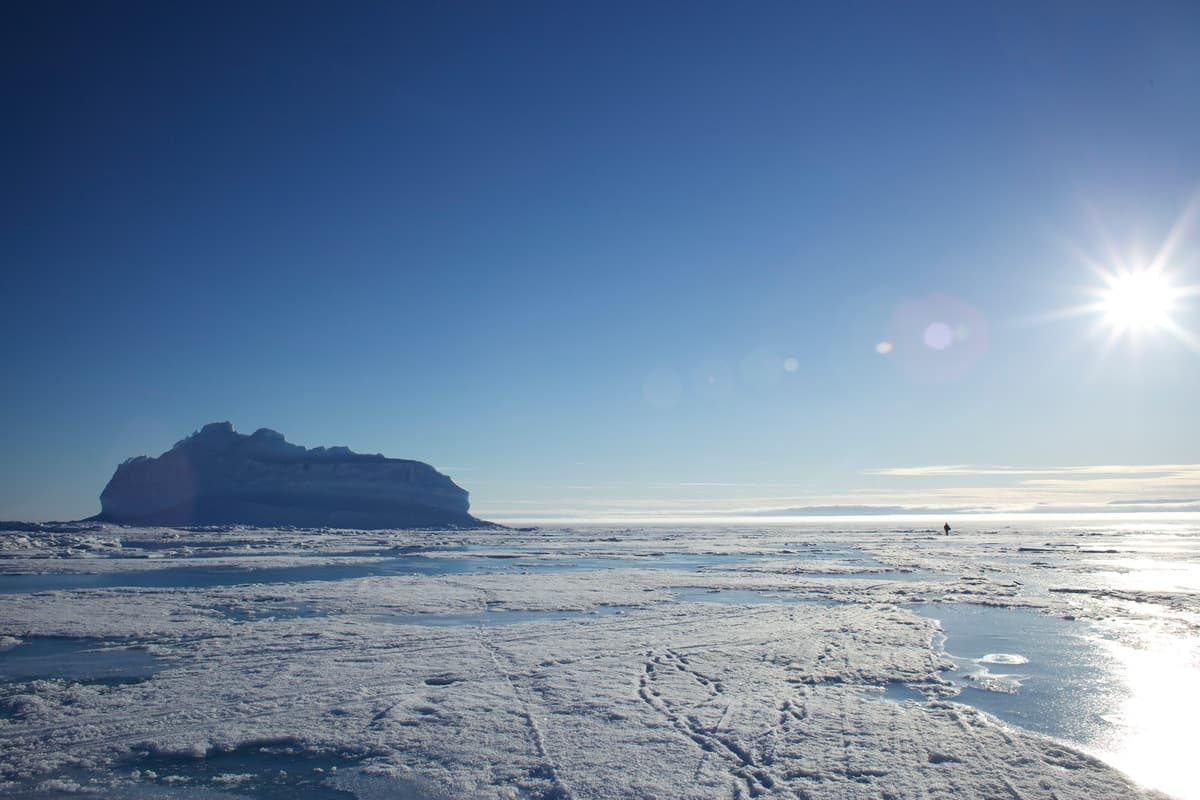
Jakeman Glacier, Jones Sound, Nunavut, Canada, August 2024. Photo credit: Patrick White, Dalhousie University
In brief
Retreating glaciers reshape Arctic marine ecosystems
As marine-terminating glaciers—glaciers that extend into the sea—retreat from the waters around Grise Fiord in Nunavut, Canada, they may be reshaping Arctic marine ecosystems in unexpected ways.
New research led by Patrick White, a PhD student at Dalhousie University in Canada, found that glaciers extending into the ocean help draw nutrient-rich deep water to the surface, supporting blooms of phytoplankton—the microscopic organisms that form the foundation of Arctic marine food webs and are an important food source for many zooplankton.
Revealing a changing Arctic
But as glaciers retreat onto land, that natural nutrient pump weakens, shifting marine ecosystems toward smaller phytoplankton that are adapted to nutrient-poor waters. The result could be reduced productivity throughout the food web.
The research was conducted in collaboration with Inuit experts, whose local knowledge enabled researchers to safely navigate and sample near the glaciers.
White’s fieldwork also produced Small boats, big glaciers, a photograph that won a jury prize in a 2025 photography competition organized by the Natural Sciences and Engineering Research Council of Canada.
The image (shown above) captures one of the tidewater glaciers at the heart of the study and highlights how scientific research, local collaboration and photography can together reveal the changing Arctic.
Note: Information, findings, and viewpoints presented in articles authored by external contributors are their own and do not necessarily represent WWF positions, policies, or interpretations. For general inquiries, please email info@arcticwwf.org.
By WWF Global Arctic Programme