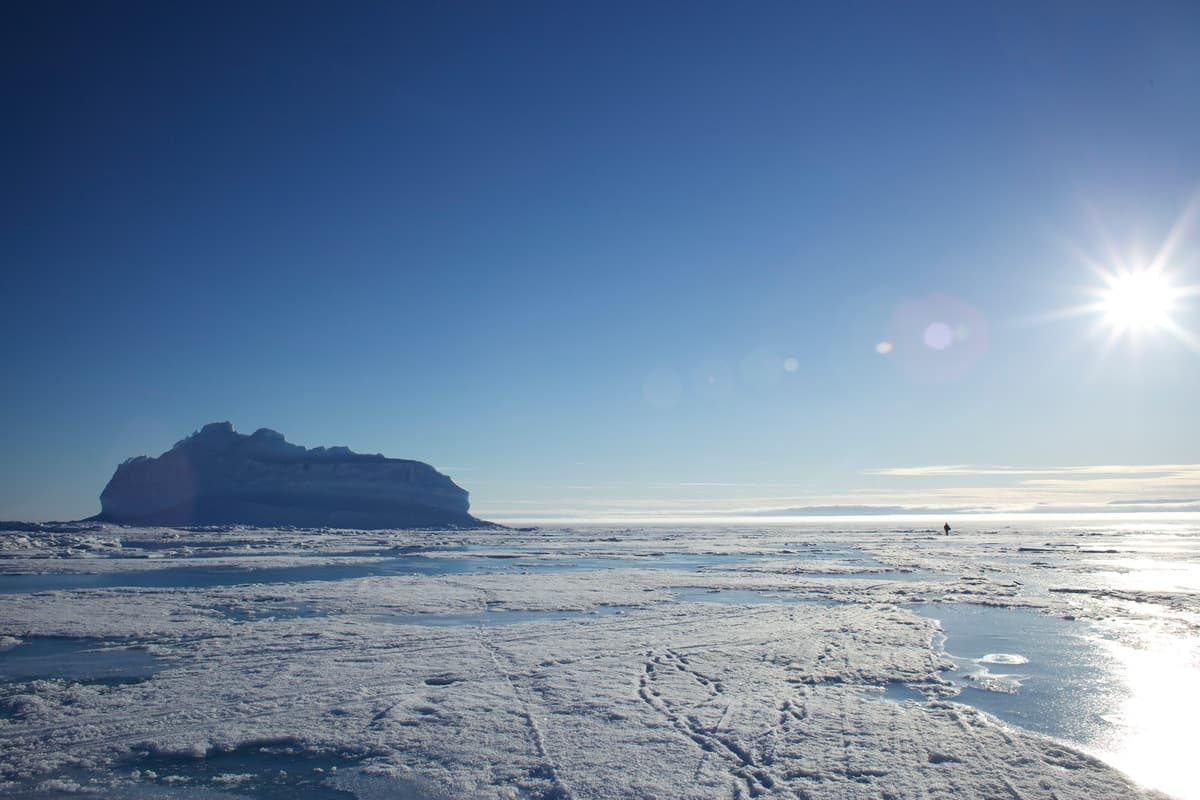
Melanie Lancaster searches for bear prints in Svalbard. Credit: © Micaela Hellström / WWF
The ice shed
Safeguarding the Last Ice Area
MELANIE LANCASTER, a senior specialist in Arctic species conservation with WWF’s Global Arctic Programme, spoke with The Circle about why the Last Ice Area’s multi-year ice matters and what governments must consider to protect this unique ecosystem.
Summer sea ice underpins Arctic marine ecosystems, supports Inuit communities, and helps regulate the global climate. Yet its extent is shrinking rapidly. As the ice thins, retreats and becomes increasingly unstable, scientific projections show that the northernmost reaches of Canada and Greenland will be a final stronghold for multi-year ice—a last refuge for species that depend on it.
Known in Inuktitut as Similijuaq (“place of the big ice”), this region is one of the most critical climate refuges in the circumpolar world.
WWF was the first to call it the Last Ice Area, a term that underscores both its global significance and the urgency of safeguarding it.
Today, Indigenous Peoples, scientists and conservation organizations like WWF are reassessing what must be done to ensure this stronghold endures.
What do we know about how the ice in the Last Ice Area forms and moves?
We have good science showing that much of the ice that ends up in the Last Ice Area is formed elsewhere—in the Central Arctic Ocean and surrounding seas, especially the Laptev and East Siberian seas in Russia.
Wind and ocean currents circulate the ice around the Central Arctic Ocean until it ends up at the northern coastlines of Greenland and Canada. The source of ice for the Last Ice Area—called the “ice shed” by scientists—is dynamic. It is projected to change in size and location over time as climate heating continues.

Melanie Lancaster
Knowing where the ice in the Last Ice Area originates tells us that the area is not isolated. What happens in these other places could affect the integrity of the ice that ends its journey in the Last Ice Area and creates that lasting habitat for the species and ecosystems that need it.
Melanie Lancaster, Senior Specialist Arctic Species Conservation, WWF Global Arctic Programme
Why does the age of the ice matter? What makes multi-year ice so important?
Multi-year ice is ice that has survived a summer. That means it goes through summer without melting and continues to build up the following winter.
As the ice survives multiple summers, it gets thicker and fresher (meaning less salty, because salt is gradually flushed out of the ice). It also collides with other ice pieces, forcing them to pile up into ridges—a process known as pressure ridging—and creating complex 3D icescapes above and below the surface.
When ice is first formed, it has a very flat undersurface. That’s one reason why young ice can act like a sounding board—underwater noise from ships bounces off it. But older ice has ridges that act like sound baffles, muffling underwater noise.
The shape and freshness of multi-year ice also make it a crucial building block for the Arctic marine food web by providing habitat for algae and other microscopic organisms that form the foundation of the Arctic Ocean’s unique sea ice ecosystem. Ringed and bearded seals and polar bears also use multi-year ice.
Finally, while annual sea ice melts in summer and exposes a dark, open ocean, multi-year ice blankets the ocean’s surface with thick, bright white ice, reflecting much more sunlight back to the atmosphere. This helps keep the planet cool.
Why is it important to protect the Last Ice Area?
The Last Ice Area has been identified as a climate refuge because it is predicted to retain summer sea ice longer than anywhere else in the Arctic.
When we talk about ice-dependent species, we generally think of polar bears, walrus, seals, fish, microscopic invertebrates and algae—species that have evolved with sea ice and still need it.
Conditions will become very challenging for a lot of those species as the Arctic Ocean loses more sea ice.
But the Last Ice Area—and everything that lives around it—will essentially be a safe haven because conditions will not get quite so hard there. Life will be safest there.
Given that the Last Ice Area spans Canada and Greenland, and is fed by the Central Arctic Ocean, what challenges are involved in protecting it?
Huge challenges. Protecting the Last Ice Area is a truly multilateral and international effort that will require courage and innovation from all responsible parties. The area sits within the exclusive economic zones of Canada and Greenland—the waters where each has rights over natural resources.
As our understanding of the region has increased, we’ve realized that measures will also likely need to be taken in the Central Arctic Ocean.
Because the Last Ice Area is so connected to the rest of the Arctic Ocean (through the transport of sea ice), we need to consider industrial activities across the ocean, including within the exclusive economic zones of the different Arctic coastal states, to really grasp the risks for this climate refuge.
Sea ice that feeds the Last Ice Area should remain intact and free of pollutants—including oil from offshore exploration and extraction projects happening elsewhere in the Arctic, which is easily transported in sea ice and practically impossible to clean up.
Given that much of the Last Ice Area lies in Canadian and Greenlandic waters, how much responsibility do these two nations have to protect it?
Emerging international mechanisms, including the new Biodiversity Beyond National Jurisdiction Agreement (or High Seas Treaty), could help protect the ice shed. Canada, Greenland and Denmark could be leaders in proposing protections in the Central Arctic Ocean ice shed.
Strong action from all Arctic governments remains essential.
Greenland and Denmark have yet to put specific protections in place for the portion of the Last Ice Area that sits within Greenland’s waters. But in 2019, in partnership with the Qikiqtani Inuit Association, the Government of Canada designated Tuvaijuittuq—meaning “the place where the ice never melts”—as an interim marine protected area in the Canadian portion of the Last Ice Area. This interim status was renewed in 2024 for another five years.
Considering the loss of sea ice that we are witnessing, what questions are WWF and others asking about the future of this refuge?
We are working on questions like:
What do we need to consider to make sure the Last Ice Area persists for as long as possible as a climate refuge, for the benefit of nature and people?
What geographic and time scales do we need to consider?
Which features should we focus on to maintain ecological function and cultural continuity?
What conservation measures are needed, and to manage what, and how can we implement these?
And finally, how can this be done successfully in a rapidly changing place that will look different in 10 years?
We still have the chance globally to act on climate change. If we can slow that warming so ice continues to form, we can hope for a time in the future when sea ice recovers.
In the meantime, if we want to give nature the best chance, there is also much to be done in the Arctic itself.

Multi-year sea ice distribution in the Arctic Ocean in March 2026 (left), near the end of the winter ice-growth season, and in September 2025 (right), near the end of the summer melt season. Colours indicate sea ice age, progressing from younger ice in light blue to the oldest ice in red. The oldest ice is concentrated in the Last Ice Area and Central Arctic Ocean.
Source: Grosfeld, K.; Treffeisen, R.; Asseng, J.; Bartsch, A.; Bräuer, B.; Fritzsch, B. et al. (2016). Online sea-ice knowledge and data platform , Polarforschung, Bremerhaven, Alfred Wegener Institute for Polar and Marine Research & German Society of Polar Research, 85 (2), 143-155, doi:10.2312/polfor.2016.011 (PDF).
By WWF Global Arctic Programme